
Cadence /
Make space for what is next.
A light blue calendar workspace brings the week, host filters and appointment details together. The interface preview supports local appointment creation and conflict checks, with a day view on small screens.
- Practice
- Digital products
- Built by
- Lumia Digital
- Application
- Independent source & workspace
- Current release
- Local / September 2026
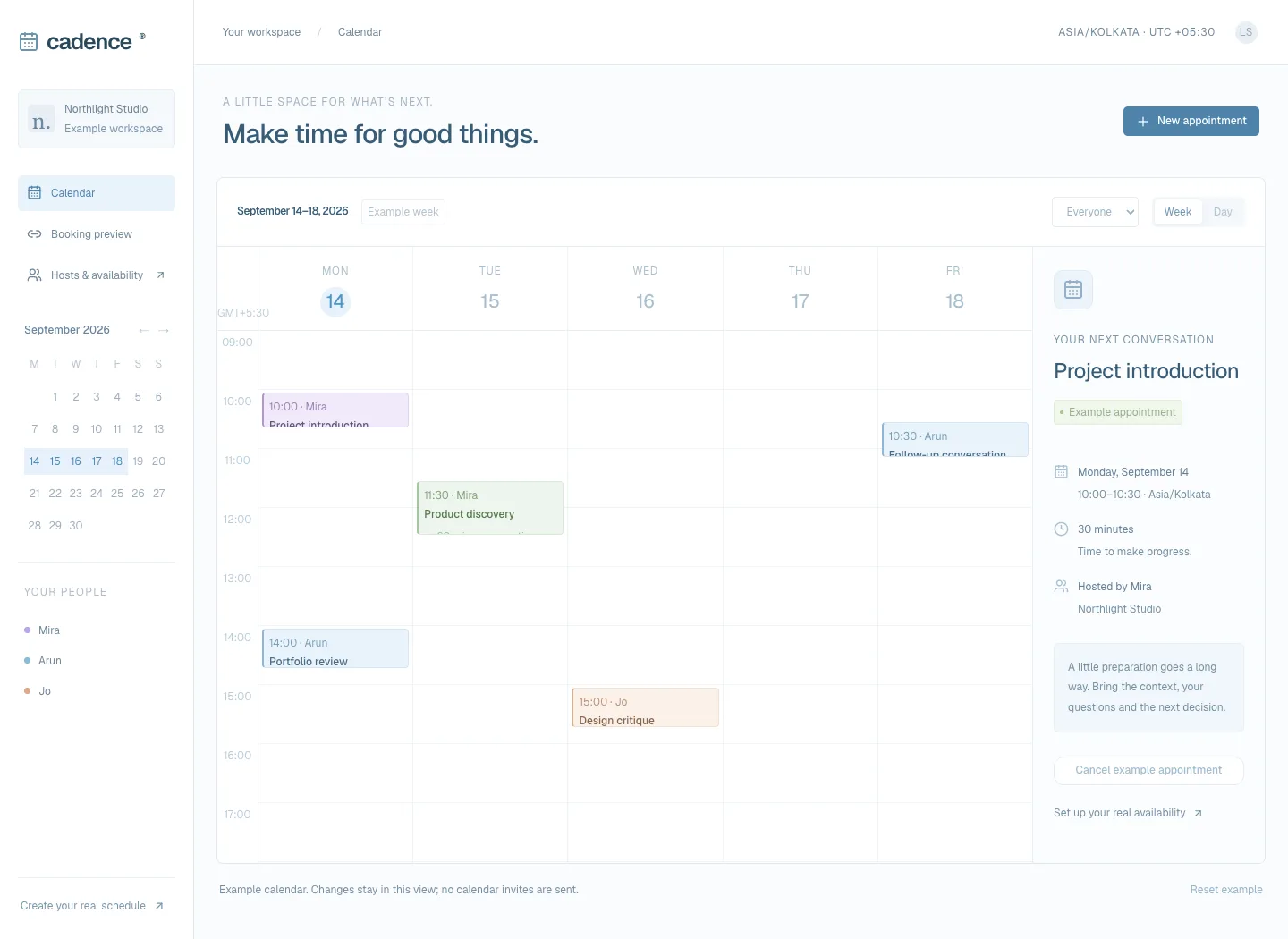
An appointment app with room to breathe.
A light blue calendar workspace brings the week, host filters and appointment details together. The interface preview supports local appointment creation and conflict checks, with a day view on small screens.
FullCalendar and Luxon schedulingThe problem worth solving.
A time slot can look available in two windows at once. One person begins a reservation while another confirms an overlapping appointment, or an abandoned checkout appears to occupy the schedule indefinitely. Local time adds another complication: a clock transition can make apparently valid start and end times cross an interval when the resource is closed.
Cadence models a reservation as a lifecycle. A resource has explicit working hours and timezone. A temporary hold protects a candidate interval for a limited period; an operator confirmation creates the booking. Cancellation and expiration release capacity according to server-side rules, so the schedule does not depend on whether somebody left a browser tab open. Conflicting actions receive an explicit result rather than two contradictory confirmations.
This independent Lumia application focuses on capacity-one resources such as a room, an individual appointment calendar or a dedicated service station. Its acceptance fixtures exercised simultaneous holds, exact interval boundaries and a repeated daylight-saving hour. They demonstrate behavior under those controlled conditions, not customer bookings, payment collection or a guarantee of universal scheduling correctness. The intended benefit is an understandable record of who has reserved which resource and whether that reservation is still valid.
Designed for: Appointment and facility operators reserving one room, person or service station per resource, with operator confirmation and explicit local working hours.
From input to a useful result.
Define the actual resource
Create a resource with its recognized timezone, weekly working intervals and hold duration. The current model uses capacity one. Set hours for the resource's local day and review any blocked periods before sharing availability. Separate independently bookable rooms or people into separate resources rather than inflating capacity beyond the supported reservation contract.
Place a temporary hold
Choose a future interval and enter the customer's required details. The server checks the full interval against working hours, blocked periods and other active holds or confirmed bookings. A hold temporarily protects capacity but is not yet a confirmed appointment. If a competing request wins, choose another available time instead of assuming the original request succeeded.
Confirm or release explicitly
An authorized owner confirms an active hold after reviewing its details. Repeating the same confirmation returns the saved booking rather than creating another appointment. Cancel an abandoned hold or confirmed booking through its appropriate action. An expired hold cannot be revived by a late confirmation; create a new hold after rechecking current availability.
Retain the appointment record
Reload the saved booking to verify its status and timestamps. The application provides an ICS calendar export for the booking record; distributing or importing that file is a separate step. Do not describe a temporary hold as paid or confirmed. The tested local confirmation mode records payment as not required and does not collect a charge.
What the software actually did.
These results come from internal workflow testing of the local product. The records are controlled test inputs; customer deployments and commercial impact have not been measured.
Concurrency and boundary behavior
Fourteen Cadence HTTP checks passed. Two concurrent requests for the same interval produced exactly one successful hold and one conflict. A booking adjacent to the end of another interval was accepted, while a one-minute overlap was rejected. A zero-length request failed validation. These controlled races exercise capacity conservation for the supported single-resource model.
Confirmation, cancellation and expiry
Replaying confirmation returned the same saved booking. Cancelling it freed the interval for another hold. Explicit hold cancellation was idempotent, prevented later confirmation and immediately released capacity. A separately configured one-second hold expired without page activity, refused confirmation and permitted a replacement reservation. The expiry test reads the API's actual numeric epoch-millisecond field.
A concrete repeated-hour regression
For America/New_York Sunday hours 01:30–02:30, a request from 2026-11-01T05:45Z to 07:15Z was rejected as OUTSIDE_HOURS because the fall-back transition crosses the repeated closed 01:00–01:29 period. The shorter positive control starting at 06:30Z succeeded. This records one important transition scenario rather than claiming every timezone edge has been exhaustively tested.
Make the boundary clear.
- Each resource supports capacity one; group inventory, pooled capacity and multi-resource atomic booking need a different model.
- Reservations are future, whole-minute intervals of at most 12 hours and must remain within a supported local working day.
- The tested confirmation is operator-managed with payment not required. It does not represent a paid reservation or a payment authorization.
- ICS export is a downloadable record, not verified email delivery or two-way synchronization with Google or Microsoft calendars.
- The daylight-saving test covers a specific New York fall-back boundary. Spring-forward and broader timezone coverage remain separate acceptance work.
Questions before you start.
Is a hold a confirmed booking?
No. A hold reserves capacity temporarily. An authorized operator must confirm it before expiry to create a confirmed booking in the demonstrated workflow.
What if two people choose the same time?
The server evaluates competing holds against persisted availability. The tested simultaneous requests had one winner and one conflict; the losing request must choose a different available interval.
Does capacity remain blocked when someone closes the tab?
Only active, unexpired holds count against capacity. The one-second expiry test released the interval without any page activity, and late confirmation was rejected.
Does Cadence take payment or update my external calendar?
The tested local mode does not collect payment. It provides an ICS export, but importing or sending it is separate from a verified external calendar integration.
More from this practice.
All fifteen products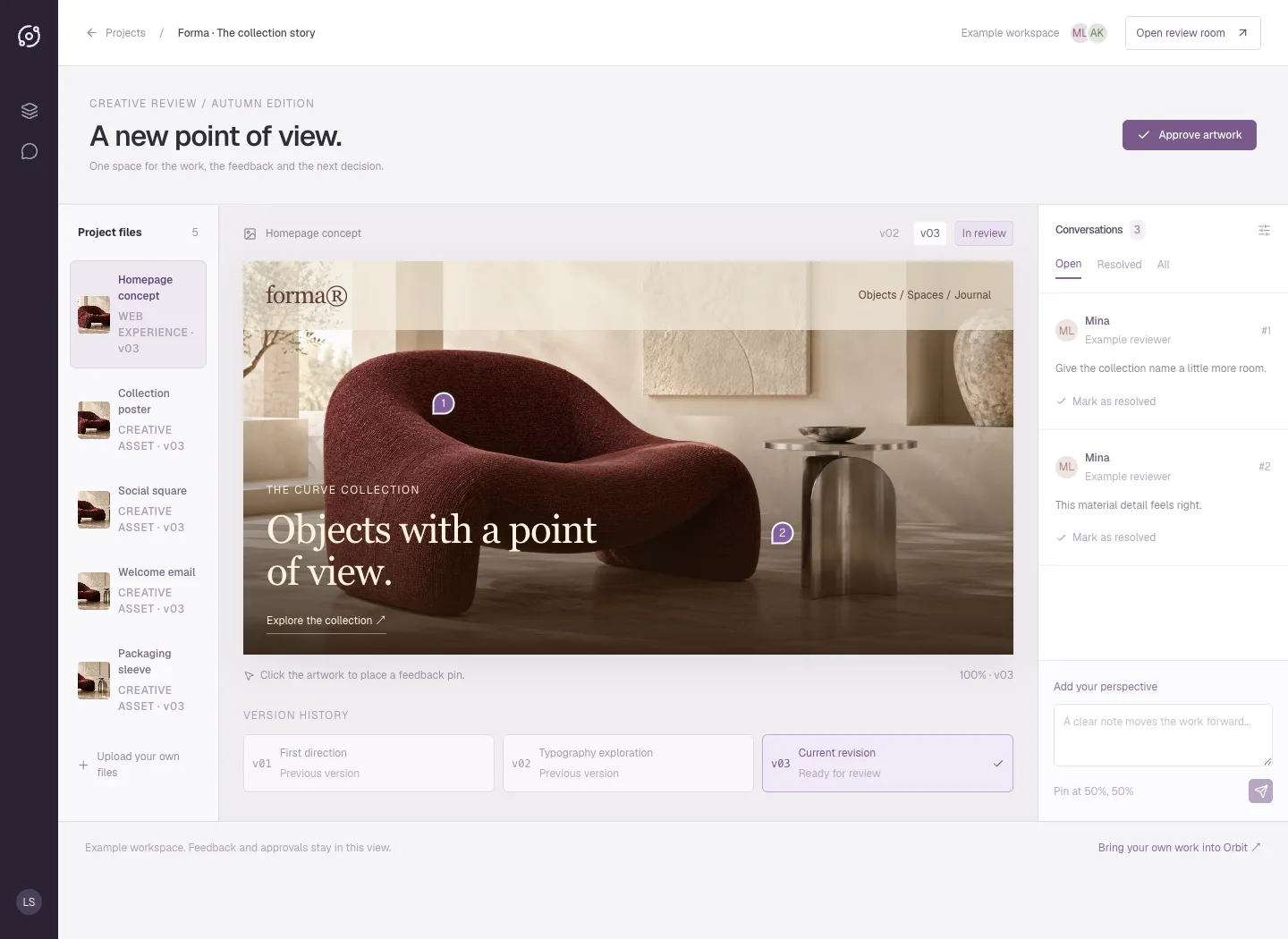
Orbit
A plum review room puts the artwork at the centre, with a project-file rail, version history, numbered pins and threaded feedback. The public interface is an interactive example of a full-stack creative-review app.
Explore the case study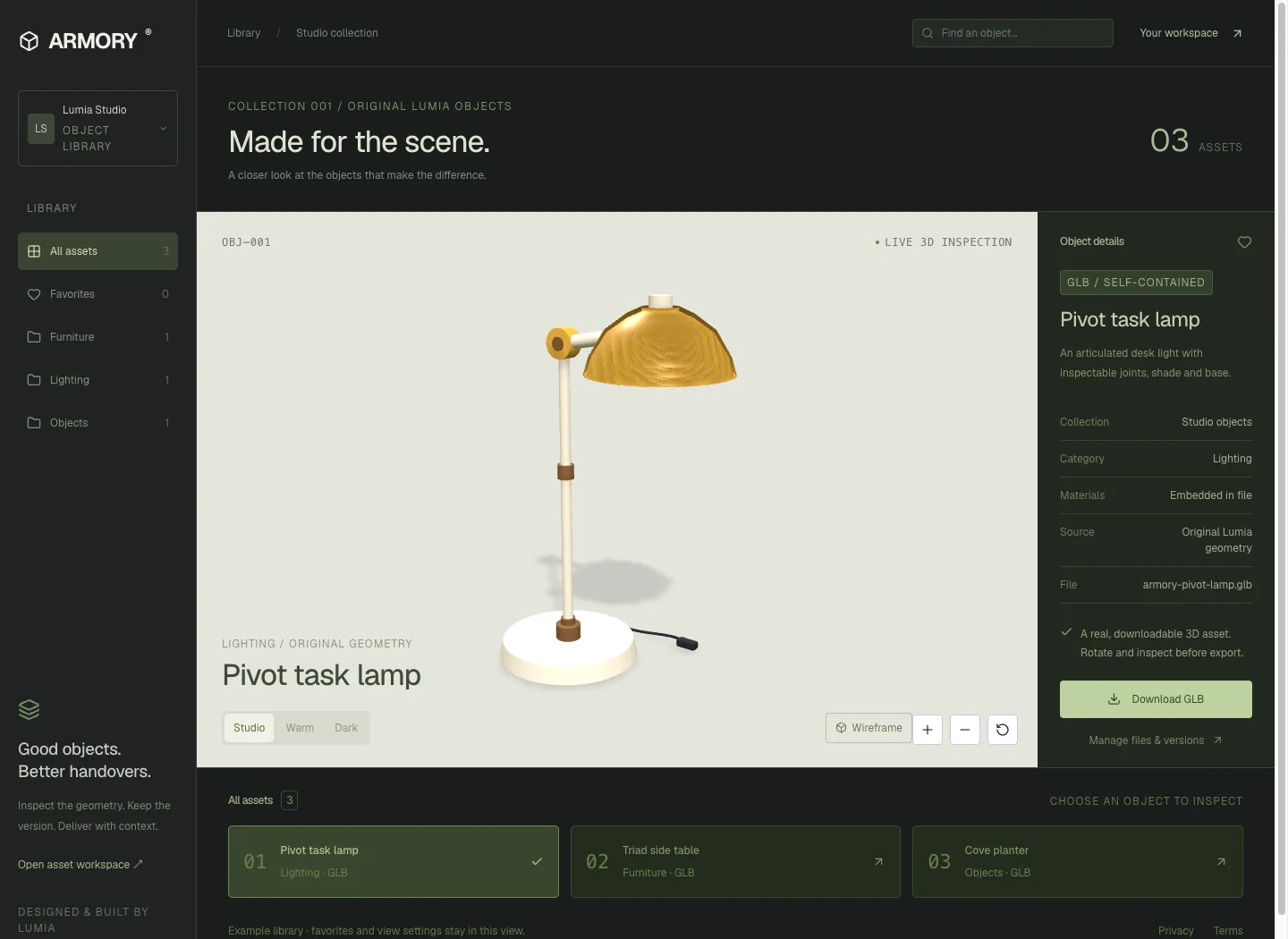
ARMORY
A mineral-green asset workbench pairs a large interactive 3D stage with an object inspector and collection shelf. Three original GLBs can be inspected and downloaded from the public interface.
Explore the case study