
ForgeQuote /
From an RFQ to a quote you can defend.
Turn unstructured requirements into reviewed, precisely priced quotations with traceable catalogue versions.
- Practice
- AI & automation
- Built by
- Lumia Digital
- Application
- Independent source & workspace
- Current release
- Local / September 2026
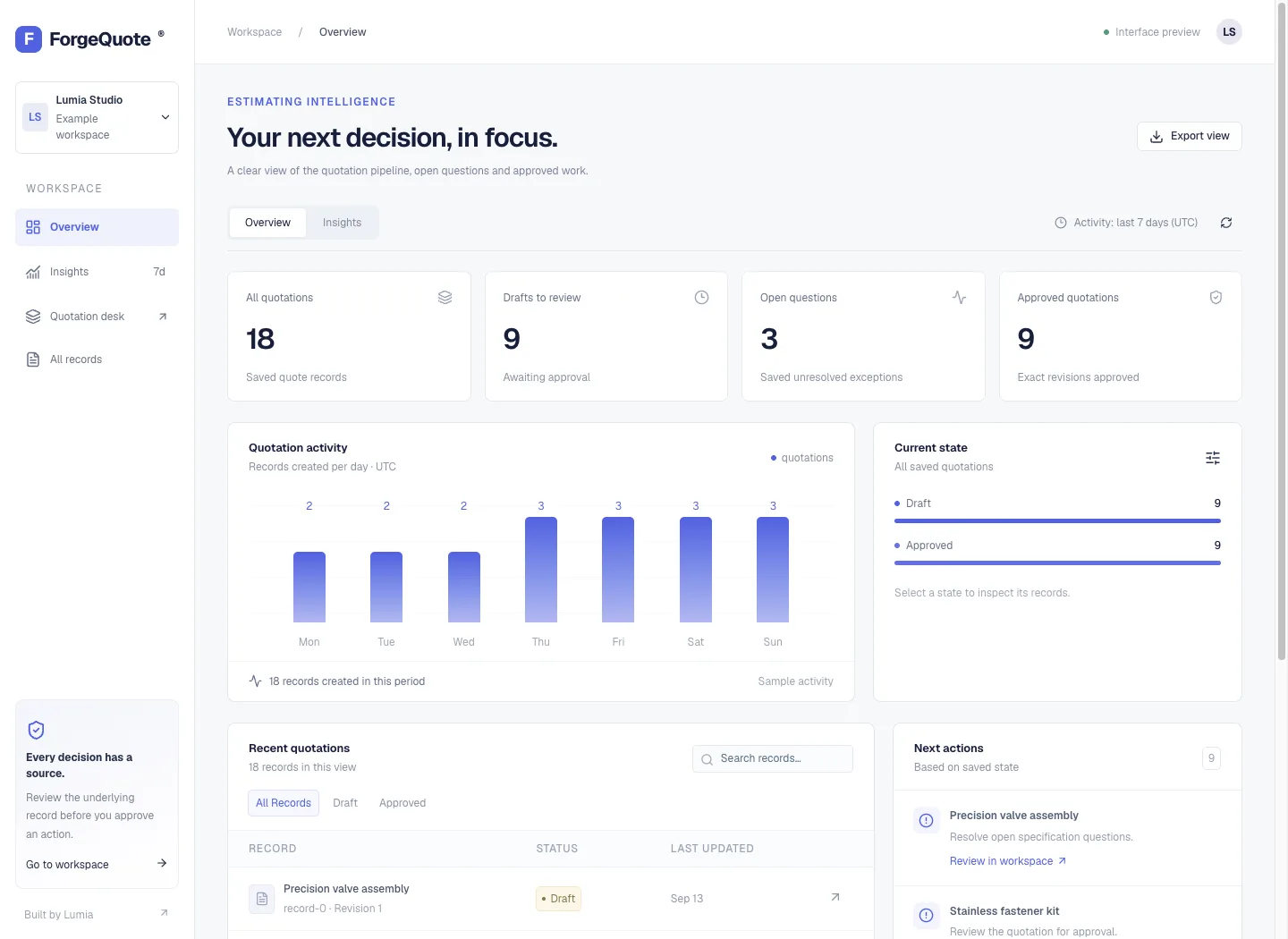
A clear quotation control centre.
An indigo estimating dashboard combines quotation activity, open questions, state filters and a review queue. The private workspace calculates its insights from saved quote records.
AG Grid quotation worksheetSee how ForgeQuote thinks.
Every Lumia system earns its own operating language. This view shows the decision surface, evidence trail and human checkpoint built around this workflow.
250
500
Imported drawing / job 0382
Confidence 96.4%
Bracket assembly
stainless · 2.5 mm · batch of 40
Interface study / controlled local workspace / human review remains in the loop.
The problem worth solving.
An industrial enquiry can mix part names, quantities, units and incomplete specifications in a short email. Turning it into a quotation requires interpretation, but the price itself should come from an identified commercial source. If interpretation and calculation are mixed together, a fluent answer can conceal an unknown part, an outdated rate or an arithmetic error that a reviewer cannot easily trace.
ForgeQuote separates those jobs. The operator supplies a catalogue with named price version, currency, SKU, unit and price. Requirements are linked to the customer's source text, optionally assisted by structured model extraction. The application calculates totals from the selected catalogue and exposes clarification items for review. Approval belongs to the current quote revision, so editing its quantities creates a new decision rather than preserving an obsolete sign-off.
This is a focused independent Lumia application for catalogue-based quotations, evaluated with synthetic industrial parts. Its intended value is a clearer review path from enquiry to priced document. It is not evidence of a manufacturing customer deployment, faster sales or validated demand. The useful boundary is explicit: interpret the request, use known rates, resolve uncertainty, then let the responsible person approve the resulting quotation.
Designed for: Industrial distributors, small manufacturers and technical sales operators whose quotations use a maintained SKU catalogue and whole-unit quantities.
From input to a useful result.
Name the commercial basis
Create a catalogue using the supported currency, tax basis points and a meaningful rate-version label. Add unique SKUs, descriptions, units and integer minor-unit prices. Review the catalogue before quoting from it. Use a separate price version when commercial rates change rather than assuming a saved quotation has automatically adopted a new rate.
Read the enquiry with its context
Enter the authorized RFQ text and select relevant catalogue context. Optional extraction suggests SKU, quantity and unit alongside a source quotation. Compare every extracted requirement with the original text. Unknown items and missing details require clarification; a model response does not provide authority to invent a catalogue price or substitute a different specification.
Build and review the quote
Create source-linked lines with positive whole quantities. Check descriptions, units, currency and the named price version. Inspect subtotal, tax and total, then resolve each recorded exception before approval. If a quantity changes, save the revision and review its new digest rather than attempting to approve an earlier version of the calculation.
Approve and export deliberately
An owner approves the reviewed quote revision. Download its PDF or CSV for the next commercial step and retain the source references with the document. The exported state distinguishes a draft from an approved quote. Sending a quotation, accepting an order or updating a CRM remains a separate operator action in the tested local installation.
What the software actually did.
These results come from internal workflow testing of the local product. The records are controlled test inputs; customer deployments and commercial impact have not been measured.
Money and revision checks
Twelve ForgeQuote HTTP checks passed. The calculation fixture used three units priced at 1001 minor units with 1800 tax basis points: subtotal 3003, tax 541 and total 3544. Tests checked idempotent quote creation, rejected fractional quantities, stale versions and incorrect approval digests, plus revision invalidation after an approved quote's quantity changed.
Missing commercial facts remain blocking
An unknown catalogue SKU did not receive an invented price. The supported-money boundary either retains exact arithmetic or returns an explicit validation failure; the tested large boundary was covered by the harness. Separate workspace access could not read the quotation. These checks assess defined rules, not whether a user's catalogue rates or specifications are commercially correct.
One traceable model extraction
A consented synthetic request, Supply 12 BOLT-M8 each, completed through the application using Gemini 3.1 Flash-Lite. The requirement retained quantity 12, unit each and a verbatim source quotation. Consent false returned DATA_CONSENT. Replay and reload returned the same persisted execution data. This single short example does not establish general RFQ extraction accuracy or a latency guarantee.
Make the boundary clear.
- Supported currencies are INR, USD, EUR and GBP with two-decimal money handling; quantities are positive whole-unit strings.
- Rates, catalogue names, units, tax inputs and exception resolutions are supplied by the operator. The application does not validate their commercial correctness.
- Extraction tests used owned synthetic text. Confidential customer enquiries require an appropriate provider/data-handling decision before any external model request.
- No ERP inventory check, supplier availability, live price feed, outbound email or CRM write was verified in this local workflow.
- An exported draft remains a draft. A downloaded document is not evidence that a recipient received or accepted a quotation.
Questions before you start.
Can the AI invent a price for an unknown part?
The implemented quote handler requires the SKU to exist in the selected catalogue and rejects unknown items. Clarify or add a reviewed catalogue entry before creating a valid quote line.
What changes after I edit an approved quote?
The saved revision receives a new digest and returns to draft. The earlier approval cannot authorize the changed quantities or calculation.
Does it send quotations automatically?
The verified workflow creates, reviews and exports a document. Sending email, updating a CRM or obtaining customer acceptance is not part of the tested local path.
Why keep the source quotation?
It lets the reviewer compare the extracted requirement with the original enquiry. It supports review of interpretation; it does not prove that the customer's request is complete or technically suitable.